Frame size guide
Frame size comes down to five measurements: lens width, bridge, temple length, lens height and total front width. Measure a pair that fits you well and compare those numbers with any frame before you order.
Read the numbers on the temple
Most frames print a set of numbers inside one temple arm, such as 52-18-140. The first is the lens width, the second the bridge width and the third the temple length, all in millimetres. Some brands add a lens height or a model code.
Those three numbers do not include total front width, which is often the best single guide to fit.
The five measurements
| Measurement | What it tells you |
|---|---|
| Lens width | How wide each lens opening is; affects where your eyes sit. |
| Bridge | The gap between the lenses over your nose; affects comfort and height. |
| Temple length | From hinge to tip, including the bend behind the ear. |
| Lens height | The vertical depth of the lens; progressives need enough of it. |
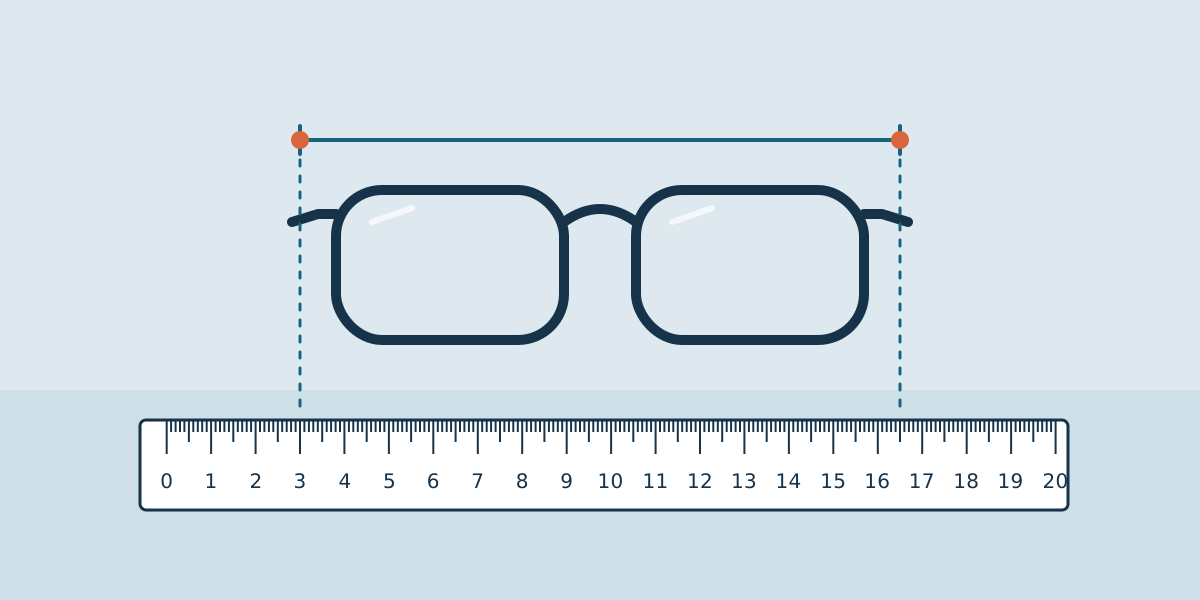
| Front width | The whole frame from edge to edge; the best guide to overall fit. |
How to measure a frame you own
- Lay the glasses on a table with the lenses facing you.
- Measure one lens opening horizontally at its widest point.
- Measure the bridge gap between the two lenses at its narrowest point.
- Measure the lens opening vertically for lens height.
- Measure the whole front from the outer edge of one hinge to the other.
- For temple length, follow the arm from the hinge to the tip, including the curve.
Compare like with like
Our product pages list these measurements. Compared with a pair that fits you, within 2 mm is a close match for lens width and total frame width, and within 5 mm for temple length. For the bridge, allow 2 mm on frames with adjustable nose pads but stay within 1 mm on a plastic bridge, which cannot be adjusted. Temples between 135 and 150 mm fit most adults.
Size labels
We group frames into five sizes by total frame width, measured across the front from the outer edge of one hinge to the other. Use the size to narrow the list, then check the numbers.
| Size | Total frame width | Lens width, if no frame width |
|---|---|---|
| Extra narrow | Up to 118 mm | Up to 46 mm |
| Narrow | 119–125 mm | 47–49 mm |
| Medium | 126–132 mm | 50–53 mm |
| Wide | 133–140 mm | 54–56 mm |
| Extra wide | 141 mm or more | 57 mm or more |
When a listing has no frame width, we size the frame by its lens width and adjust for the bridge: a bridge of 15 mm or less moves it one size smaller, and 19 mm or more moves it one size larger. Those sizes are marked approx.
Adult sizes only. We do not sell children's frames, so there is no kids' size table.
Bridge fit
The bridge carries most of the frame's weight. If it is too narrow, the frame sits high and presses on the sides of your nose; too wide, and it slides down. Metal frames with adjustable nose pads can be fine-tuned, while acetate frames with a moulded bridge depend more on the number being right.
Lens height and progressives
Progressive lenses need room for distance, intermediate and near zones. Frames with a very shallow lens cannot fit all three, and the product page notes when a frame is not suitable for progressive lenses. If you wear progressives now, compare the lens height of your current pair.
When numbers are approximate
Some supplier listings give only part of the measurements. In that case we estimate from the frame's material template and mark the value as approximate. Treat it as a close guide rather than an exact figure.
Related guides
Find your fit
How a good fit should feel.
Progressive lenses
Why lens height matters.
Square glasses
Compare sizes in a popular shape.
Frame size questions
What does 52-18-140 mean on my glasses?
Lens width 52 mm, bridge 18 mm and temple length 140 mm.
Is a bigger lens width always a bigger frame?
Not always. The bridge and the frame's edges also add width, which is why total front width is the better comparison.
Some measurements say approx. Why?
Where a supplier has not given an exact figure, we show an estimate from the frame's material template and label it as approximate.
How wide should my frames be?
About as wide as your face at the temples. The total front width of a pair that already fits you is the best guide.
Find your next frame
Compare shapes and measurements, then explore suitable lens options.
Shop eyeglasses