How to adjust your glasses
Most fit problems come from three places: the temples, the nose pads or a loose screw. You can tighten screws and clean contact points safely at home; bending frames is best left to an optician.
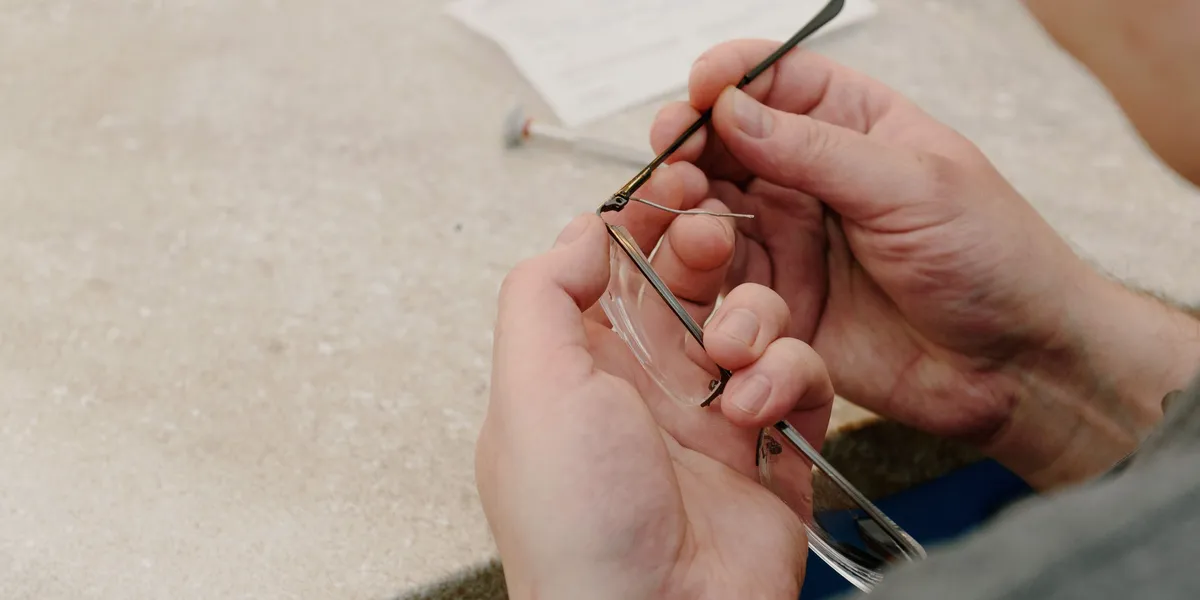
Find the problem first
- Sliding down your nose: temples too loose or nose pads too wide.
- Pressing behind the ears: temples bent too tightly or too short.
- Sitting crooked: one temple bent differently from the other.
- Marks on your nose: nose pads too narrow or at the wrong angle.
- Wobbling hinge: a loose screw.
Check whether they are straight
Place your glasses upside down on a flat table. Both temple tips should touch the surface. If one lifts, the frame is out of alignment and will sit crooked on your face.
What you can do safely
- Clean the nose pads and temple tips with mild soapy water; oil and dirt make frames slip.
- Tighten a loose hinge screw gently with a matching precision screwdriver.
- Stop if the screw resists, the thread is damaged or the frame flexes.
Leave shaping to an optician
Do not use boiling water, a hair dryer or force to bend a frame. Acetate softens unevenly, metal can crack at a weld, and heat can damage lens coatings. Opticians use controlled heat and the right pliers, and many will adjust a frame in a few minutes. It is worth asking at a local practice even if you did not buy the glasses there.
Rimless and semi-rimless frames
These frames hold the lenses with small screws or a thin cord. Overtightening can crack a lens. Always ask an optician to adjust them.
Check your vision afterwards
Changing the fit moves the lenses in front of your eyes. If vision feels different after an adjustment, especially with progressive lenses, ask for the fitting position to be checked.
Nose pads
Metal frames usually have adjustable nose pads on small arms. If the frame sits too low, the pads may be too far apart; if it sits too high or pinches, they may be too close. An optician bends the pad arms a fraction at a time. Silicone pads can harden and yellow, and replacing them is quick and inexpensive.
Everyday habits that keep the fit
- Take glasses off with both hands, holding both temples.
- Keep them in a case, never folded on top of your head.
- Rest them lenses up, not face down on a table.
- Leave them out of hot cars and away from radiators.
When parts need replacing
Nose pads, temple tips and hinge screws wear with daily use. Replacing them is usually quick and restores the original fit. If a hinge is cracked or a frame has been bent repeatedly in the same place, ask an optician whether repair is sensible before adjusting it again.
Related guides
Find your fit
Prevent fit problems before you order.
Progressive lenses
Why position matters most for them.
Semi-rimless glasses
Light frames with care points.
Adjustment questions
Why do my glasses keep sliding down?
Usually the temples are too loose behind the ears or the nose pads sit too wide. Cleaning helps; a small adjustment by an optician fixes it.
Can I adjust acetate frames at home?
We do not recommend it. Acetate needs even, controlled heat, and uneven heating can warp the frame or damage the lenses.
What screwdriver fits glasses screws?
A precision flat or cross-head driver around 1.4 to 1.8 mm. Use one that fits the slot exactly.
My glasses leave marks on my nose. What helps?
The nose pads may be too narrow or angled wrongly. An optician can widen or reangle them, or fit softer pads.
Find your next frame
Compare shapes and measurements, then explore suitable lens options.
Shop eyeglasses